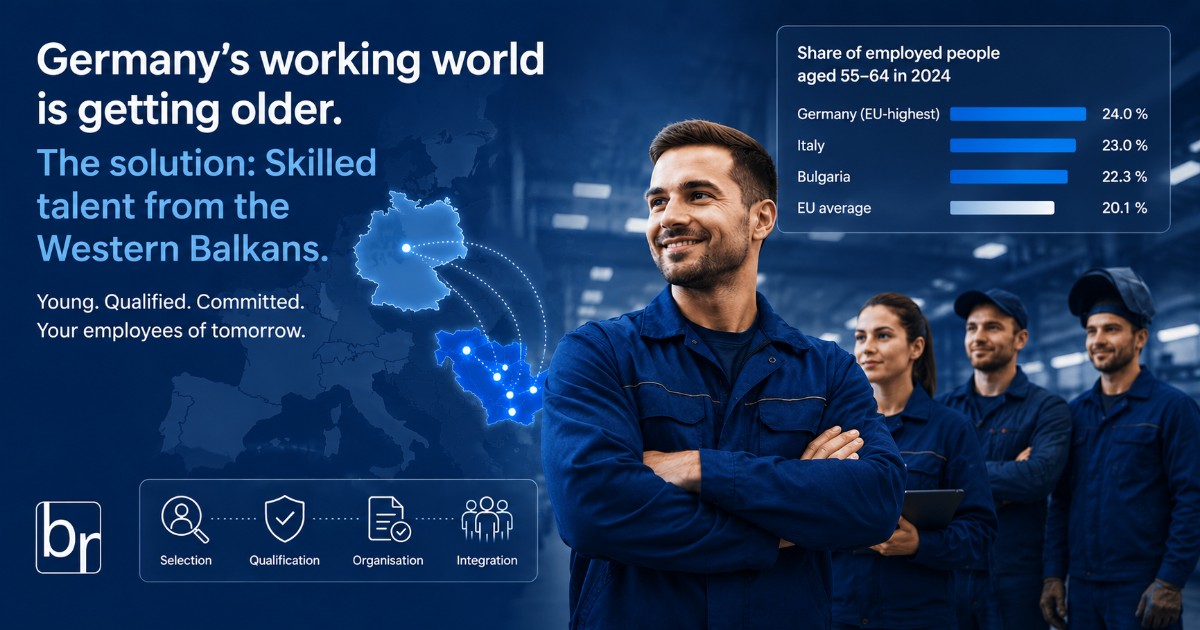
Germany is facing a development that many employers are already experiencing firsthand: workforces are getting older while the supply of qualified young professionals continues to shrink. In industries such as construction, manufacturing, logistics, skilled trades, and technical services, finding suitable employees is becoming more challenging every year.
Recent data from Germany’s Federal Statistical Office highlights just how significantly demographic change is affecting the labor market. In 2024, approximately 24% of all employed people in Germany were between the ages of 55 and 64—the highest proportion in the European Union. For businesses, this means one thing above all: competition for young, qualified workers will continue to intensify in the years ahead.
Germany Has the Oldest Workforce in the European Union
Current figures from Destatis and Eurostat reveal a remarkable trend. Of the approximately 40.9 million employed people between the ages of 15 and 64 in Germany, around 9.8 million were aged between 55 and 64 in 2024. This represents a share of 24%. Germany therefore exceeds the EU average of 20.1% by a significant margin. Countries such as Italy (23%) and Bulgaria (22.3%) follow closely behind but do not reach Germany’s level.
This development is not a short-term phenomenon. For years, the proportion of older employees has steadily increased. According to Germany’s Federal Statistical Office, around 20% of the workforce was aged 55 or older in 2014. By 2024, that figure had risen to more than 26%.
The Skilled Labor Shortage Is Becoming Structural
Many businesses still view the shortage of skilled workers as a temporary challenge. However, demographic data points toward a long-term structural shift. Over the coming years, millions of employees from the baby boomer generation will retire. At the same time, significantly fewer young people are entering the labor market.
According to projections from the Federal Statistical Office, approximately 13.4 million people will reach retirement age in the coming years.
For employers, this translates into:
- • More vacant positions
- • Longer hiring cycles
- • Higher recruitment costs
- • Increased competition for talent
- • Greater pressure on existing teams
The impact is particularly severe in occupations that require practical skills, technical expertise, or vocational training.
Skilled Trades, Construction, and Industry Are Especially Affected
Many companies in technical and trade-related sectors are already experiencing the effects of the labor shortage.
Employers are actively searching for:
- • Carpenters
- • Joiners
- • Welders
- • CNC operators
- • Electricians
- • Industrial mechanics
- • Machine operators
- • Production workers
- • Truck drivers
- • Warehouse specialists
- • Construction workers
At the same time, the number of young applicants entering vocational professions has been declining for years. Many companies report that vacancies remain open for months or that available candidates do not meet the required qualifications.
The consequences are immediate:
- • Projects are delayed
- • Production capacity remains underutilized
- • Growth opportunities are missed
- • Existing employees become overworked
Why Traditional Recruiting Methods Are Becoming Less Effective
For many years, businesses could fill vacancies through job boards, newspaper advertisements, or local recruiting efforts. Today, these methods are often no longer sufficient.
Employers increasingly report:
- • Declining application volumes
- • Fewer qualified candidates
- • Higher dropout rates during the hiring process
- • Greater competition from other employers
Particularly in regions with low unemployment rates, the situation is becoming increasingly difficult. Many businesses are now competing for the same limited pool of skilled workers. As a result, not only do labor costs increase, but the time required to fill open positions also grows significantly.
International Recruitment Is Becoming a Strategic Necessity
Against this backdrop, international recruitment is playing an increasingly important role for German employers. More and more companies recognize that they can no longer meet their staffing needs solely through the domestic labor market.
Recruiting qualified workers from abroad is therefore no longer an exception.
Instead, it is becoming an integral part of modern workforce planning and talent acquisition strategies. One of the most attractive regions for recruitment is the Western Balkans.
Why the Western Balkans Are an Attractive Talent Source
The countries of the Western Balkans have a long tradition of skilled labor, technical professions, and craftsmanship.
These countries include:
- • Bosnia and Herzegovina
- • Serbia
- • North Macedonia
- • Montenegro
- • Albania
- • Kosovo
Workers from these countries often bring qualities that are highly valued by German employers.
Strong Practical Experience
Many candidates already possess several years of hands-on experience in their profession. This is particularly true in industries such as construction, manufacturing, metalworking, logistics, and industrial production.
High Motivation
For many workers from the region, employment in Germany represents a significant long-term career opportunity. As a result, they often demonstrate strong motivation, commitment, and dedication.
Adaptability and Integration
Workers from the Western Balkans have been contributing to the German economy for decades. Their integration into German workplaces is often smooth and straightforward.
Long-Term Commitment
Many employers report high levels of loyalty and long-term retention among employees recruited from the region. In an era of increasing workforce turnover, this factor is becoming more valuable than ever.
Young Talent Will Become Even More Valuable
Current workforce demographics clearly illustrate why younger employees will become increasingly important. If nearly one in four employed people in Germany is already between the ages of 55 and 64, a substantial share of the workforce will retire in the coming years. For businesses, this means that building a younger workforce is becoming a major competitive advantage.
Young employees offer:
- • Long-term availability
- • Strong development potential
- • High willingness to learn
- • Greater workforce stability
For this reason, many employers are actively seeking candidates between the ages of 20 and 40 who are interested in establishing long-term careers.
What Employers Should Consider When Recruiting Internationally
International recruitment offers tremendous opportunities, but it also requires expertise and structured processes.
Challenges often arise in areas such as:
- • Candidate sourcing
- • Qualification verification
- • Document management
- • Visa procedures
- • Communication
- • Travel arrangements
- • Employee integration
Building these processes internally can require substantial time and resources. That is why many companies choose to work with specialized recruitment partners.
The Importance of a Reliable Recruitment Partner
The success of international recruitment depends largely on the quality of candidate selection and process management.
A professional recruitment partner can support employers by handling:
- • Candidate screening and pre-selection
- • Qualification verification
- • Interview coordination
- • Documentation support
- • End-to-end recruitment management
This significantly reduces the workload for employers while increasing the likelihood of successful, long-term placements.
Why Many German Employers Work with Balkan Recruiters
When companies are looking for young, qualified, and motivated workers from the Western Balkans, having a specialized partner makes a significant difference. This is where Balkan Recruiters comes in.
Access to Qualified Candidates
Balkan Recruiters maintains a strong network throughout the Western Balkans, providing access to candidates who are often difficult to reach through traditional German recruiting channels.
Focus on Skilled Workers
Whether in construction, manufacturing, logistics, skilled trades, or industry, the focus is on candidates with relevant experience and practical qualifications.
Transparent Processes
Employers benefit from clear communication, structured workflows, and support throughout every stage of the recruitment process.
Long-Term Workforce Solutions
Rather than providing short-term fixes, Balkan Recruiters helps companies build sustainable staffing strategies that support long-term growth.
The Next Few Years Will Be Critical
The latest data from Germany’s Federal Statistical Office clearly demonstrates where the labor market is heading. Germany now has the oldest workforce in the European Union. Nearly one quarter of all employed people belong to the 55-to-64 age group.
At the same time, millions of workers are approaching retirement.
Companies that act today will gain significant advantages:
- • More stable workforce planning
- • Reduced vacancy periods
- • Greater competitiveness
- • Sustainable growth opportunities
Conclusion: Preparing for the Future Starts Today
Germany’s labor shortage will not resolve itself. Demographic trends clearly show that employers must adopt new approaches to talent acquisition. International recruitment—particularly from the Western Balkans—offers a realistic and sustainable solution for securing qualified workers in the years ahead.
Companies that invest today in young, motivated, and skilled professionals will position themselves for long-term success. If your company is currently searching for employees in construction, manufacturing, logistics, skilled trades, industry, or technical professions, Balkan Recruiters can help you connect with qualified candidates from across the Western Balkans. By partnering with an experienced recruitment specialist, you can strengthen your workforce, secure future growth, and remain competitive in an increasingly challenging labor market.