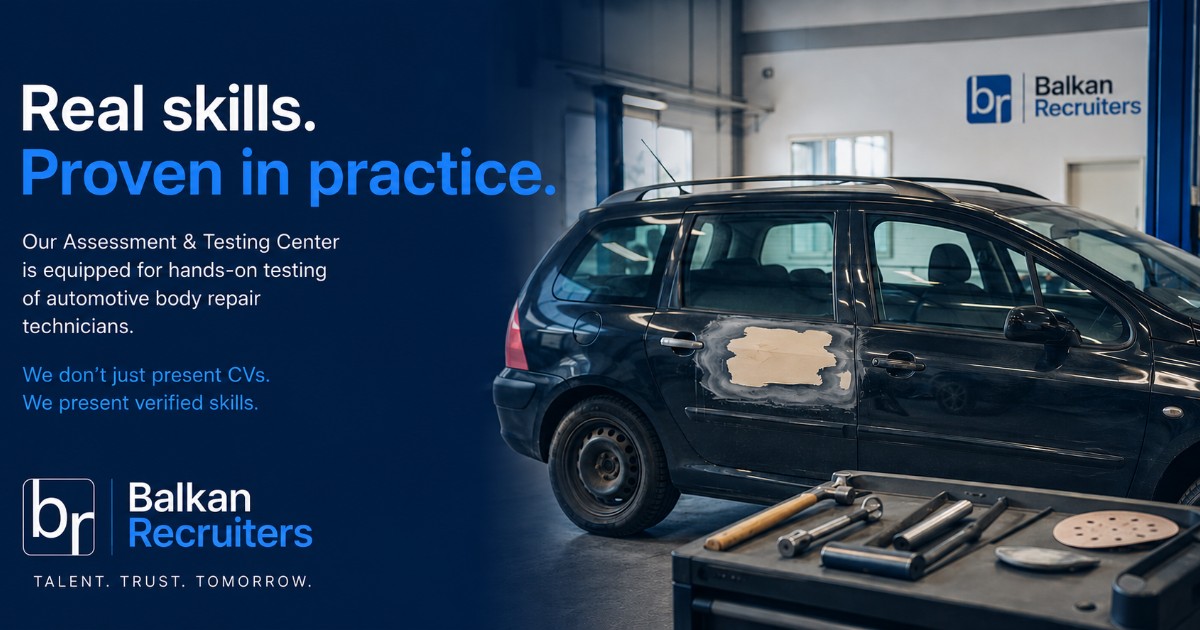
At Balkan Recruiters, we believe that technical ability should be demonstrated, not simply described on a CV. That is why we have continued investing in the development of our Assessment & Testing Center, creating an environment where skilled professionals can complete practical tasks under realistic workshop conditions. Our latest expansion focuses on automotive body repair technicians, commonly known as panel beaters or automotive body technicians.
The center has now been equipped with a dedicated test vehicle, professional body repair tools and the equipment required to assess practical skills in a structured and transparent way. This week, five automotive body repair professionals successfully completed their assigned practical tasks at our center. Their work was observed and recorded, allowing our team and partner employers to gain a much clearer understanding of their technical abilities, working methods and readiness for employment.
A Practical Environment for Automotive Body Repair Assessments
Assessing an automotive body repair technician only through a CV or interview can be difficult. A CV may list years of experience, previous employers and technical responsibilities, but it does not show how a person approaches an actual damaged vehicle. It cannot demonstrate precision, confidence with tools, organization, attention to detail or the ability to identify the correct repair method. Our Assessment & Testing Center addresses this challenge by providing a controlled workshop environment in which professionals can demonstrate their skills directly.
The newly acquired vehicle is used specifically for practical automotive body repair exercises. Together with professional tools and equipment, it allows us to create realistic tasks that reflect the type of work employees will be expected to perform in an automotive workshop. The goal is not to create an artificial examination. Instead, the purpose is to observe how each person works in conditions that are as close as possible to a real working environment.
Five Successful Practical Assessments This Week
During this week’s assessment sessions, five automotive body repair professionals completed practical tasks using the vehicle and equipment available at our center. Each participant was given the opportunity to demonstrate how they approach damaged bodywork, how they prepare the working area and how they use professional repair tools. The assessments focused not only on the final result, but also on the entire working process.
Our team observed how each person:
- Assessed the damaged area before beginning work
- Selected and prepared the necessary tools
- Organized the workstation
- Prepared the vehicle surface
- Used dent-pulling and body repair equipment
- Reshaped and corrected damaged sheet metal
- Maintained control and precision during the task
- Followed appropriate safety procedures
- Managed time and worked independently
- Evaluated the quality of the completed repair
All five professionals successfully completed their assigned tasks and demonstrated their practical abilities in front of our assessment team and camera system. This provided valuable insight that would not have been possible through a standard interview alone.
Professional Tools and Real Workshop Tasks
The center has been equipped with professional tools used in automotive body repair, including dent-pulling systems, bodywork hammers, pulling attachments, surface preparation equipment and supporting workshop tools. Participants are expected to understand how and when to use the available equipment. However, technical knowledge alone is not the only factor being assessed. We also evaluate the overall approach to the task.

An experienced automotive body repair technician should be able to inspect the damage, plan the repair process and select the appropriate method before beginning work. Starting quickly is not always the same as working effectively. A structured and careful approach often provides a better indication of professional experience than speed alone. The practical assessment therefore gives us an opportunity to observe both technical execution and decision-making.
Multi-Angle Video Recording for Greater Transparency
The practical assessments are recorded from multiple camera perspectives. This allows partner employers to review the work in detail, even when they are not physically present at the Assessment & Testing Center. Instead of relying only on written notes or a short recommendation, employers can see how a person handles tools, approaches the vehicle, completes individual steps and responds to practical challenges.
The recorded material can provide insight into:
- Tool handling
- Body position and working technique
- Repair sequence
- Precision and consistency
- Independence during the task
- Workstation organization
- Safety awareness
- Overall confidence and professionalism

This creates a more transparent recruitment process for both employers and skilled professionals. Employers receive stronger evidence of practical ability, while the people taking part in the assessment have a fair opportunity to demonstrate what they can actually do.
Moving Beyond CV-Based Recruitment
Traditional recruitment processes often place too much emphasis on written applications and interviews. This can be particularly limiting when recruiting for technical professions. Automotive body repair is a practical occupation. The quality of the work depends on experience, judgment, precision and familiarity with tools and materials. These qualities are difficult to verify through conversation alone.
Practical testing helps bridge the gap between what is written on a CV and what can be demonstrated in a workshop. It also allows us to identify strengths that may not be immediately visible during an interview. Some highly skilled professionals may not be comfortable presenting themselves verbally, especially when applying for employment abroad or communicating in a foreign language. In a practical environment, their work can speak for them.
Benefits for Employers
For employers, practical testing reduces uncertainty during the recruitment process. Hiring an automotive body repair technician from another country involves time, administrative procedures and relocation costs. A poor hiring decision can create additional expenses, delays and operational pressure. By reviewing practical assessment results, employers can make decisions based on direct evidence rather than assumptions.
The process helps employers evaluate whether an individual:
- Has the practical experience stated in their CV
- Can work independently
- Understands professional body repair procedures
- Uses tools safely and correctly
- Meets the expected quality standards
- Is ready to enter a professional workshop environment
- Requires additional training before starting work
This does not replace the employer’s final interview or decision. It provides additional information that makes the decision more objective and better informed.
Benefits for Skilled Professionals
The Assessment & Testing Center also provides an important advantage for automotive body repair professionals. Instead of being judged only by documents, language ability or interview performance, they receive the opportunity to demonstrate their practical strengths. This is especially valuable for experienced tradespeople whose technical skills may be stronger than their ability to explain those skills in a formal interview.
A successful practical assessment can help them stand out and provide employers with greater confidence in their abilities. The process is designed to be transparent, structured and directly related to the responsibilities of the position.
Continuing to Invest in Practical Recruitment
The acquisition of the vehicle and professional body repair equipment represents another step in the continued development of the Balkan Recruiters Assessment & Testing Center. Our objective is to build a recruitment process in which technical skills can be tested realistically before employment decisions are made. Following the successful assessments completed by five automotive body repair professionals this week, we will continue organizing practical testing sessions for automotive positions and other skilled trades.
By combining recruitment experience, practical assessment and multi-angle video documentation, we aim to give employers a more accurate understanding of the people they are considering for employment. CVs show experience. Practical tests reveal real skills. At Balkan Recruiters, we do not simply present professional profiles. We provide employers with verified insight into how skilled workers perform in practice.